The big ask

HIGHLIGHT

Matthew 8:10 (ESV): 10 When Jesus heard this, he marveled and said to those who followed him, “Truly, I tell you, with no one in Israel have I found such faith.

EXPLAIN

After recording the Sermon on the Mount, Matthew details several stories of Jesus’ power to heal, including a leper who asked for healing, the centurion who sought healing for his servant, Peter’s mother-in-law who had a fever and many others.

The Roman centurion was unique in that he, as a Gentile, displayed a faith that the Jews had not. He didn’t require Jesus to go with him to heal his servant. He believed that if Jesus simply said the words, it would be done.

And it was.

APPLY

In matters of prayer and faith, we must guard against “name it and claim it” theology. We also understand that God’s will is also not always to heal miraculously of disease, sickness, etc.

Unfortunately, such attempts to be doctrinally correct and not to be presumptive of God’s will and God’s grace may be a smokescreen for our lack of faith.

Do we truly believe God is not only able to take care of our needs, but also that God is willing to do so? Have we demonstrated our faith in action? Have we asked boldly, largely, and expectantly?

RESPOND

Heavenly Father, help me to learn to pray boldly, largely, and expectantly knowing your love for me. In Jesus’ name, Amen.


Waiting on the Lord

HIGHLIGHT

Psalm 130:5–6 (ESV): 5 I wait for the Lord, my soul waits, and in his word I hope; 6 my soul waits for the Lord more than watchmen for the morning, more than watchmen for the morning.

EXPLAIN

The psalmist appears to be in great despair when he sings this song. Indeed, one could imagine Jonah penning this poem, or at least forming it in his mind, as he lay in the belly of the big fish: “Out of the depths I cry to you, O LORD!” (v. 1).

The psalmist recognized that he was not perfect. Indeed, his despair may have been due to his sin and its consequences. But his hope was that if God tracked all our failures, we would surely be doomed, but he knew that God forgives freely.

So the psalmist waited upon the Lord.

APPLY

As I think about waiting upon the Lord, I think of a puppy waiting upon its master. His eyes watch his human, especially the human’s hands. He is ready to jump into action at any moment. He delights when his human is ready to play with him. He mourns when he must go away.

Do we wait upon the Lord with such fervor? Does any move of God excite us beyond measure? Are we patient, waiting for any sign of God’s activity in the world and our lives?

RESPOND

Heavenly Father, help me to wait upon you with fervor, hoping and trusting in you. Thank you for your grace and mercy, and the hope we have by trusting in you. In Jesus’ name, Amen.

Faith unrealized

HIGHLIGHT

Hebrews 11:39–40 (ESV): 39 And all these, though commended through their faith, did not receive what was promised, 40 since God had provided something better for us, that apart from us they should not be made perfect.

EXPLAIN

Hebrews 11 is the great Hall of Faith. In this chapter, we find numerous heroes of the faith who, because they trusted God, acted obediently upon that faith.

Abel offered a better sacrifice. Noah built a built. Abraham went traveling without destination set in his GPS. Moses chose to identify with slaves instead of the political elite.

Yet none of these received what was promised – the Messiah. All of these heroes looked forward in faith. But even though they did not receive the promised Messiah in their lifetimes, they continued to obey God’s will through their faith in him.

APPLY

Today, we have received the promised Messiah. Jesus is the Way, Truth, and Life. Yet I wonder if we should consider another application of this scripture: what if we never receive in our lifetime the answer to various promises God has made to us?

Take as an example the Christian parent who prays faithfully for an unbelieving child to accept Christ as Lord and Savior. Some have even felt God’s assurance that their wayward child will return from sin. Yet this parent continues to pray and believe, trusting God, until their death. We have heard various stories then of how God finally answered the believer’s prayer after entering eternity.

Do we have a faith that will persevere in trust and obedience to God, even if we do not receive what was promised in our lifetime, or when or how we expect it?

RESPOND

Heavenly Father, thank you for the example of the great heroes of faith who obeyed you in trust, even though they never received the promise of your Messiah. Help me to be faithful in obedience to you even when I receive the answer to my prayer when or how I might expect it. In Jesus’ name, Amen.

Striving to rest

HIGHLIGHT

Hebrews 4:11 (ESV): 11 Let us therefore strive to enter that rest, so that no one may fall by the same sort of disobedience.

EXPLAIN

Using God’s rest on the 7th day of creation as an analogy along with the failure of the Israelites to enter Canaan as God’s rest, the writer contends that there is another rest for the people of God, in which we rest from our works as God did (Hebrews 4:10).

Fascinatingly, the Hebrews writer immediately uses the terminology of work, “strive”, to exhort the people to enter God’s rest.

The key to understanding this tension is in the concept of obedience. The Israelites in the wilderness failed to enter Canaan because of disobedience. So those who are called by God for salvation may lose out on the opportunity to be saved by failing to obey God’s call to trust in Christ alone by grace through faith.

In the latter part of Hebrews 4 and the beginning of Hebrews 5, the writer points out that Jesus, as God in flesh, understands our weaknesses and was tempted like us, yet he did not disobey. He lived without sin.

Indeed, Hebrews 5:8–9 (ESV): 8 Although he was a son, he learned obedience through what he suffered. 9 And being made perfect, he became the source of eternal salvation to all who obey him,

APPLY

It has been ingrained in us that salvation is by grace, which is never and can never be earned, alone through faith. This is true, and we must understand that we do not gain salvation through our own striving.

Yet missing sometimes in our understanding of salvation is that faith is much more than an intellectual agreement that Jesus is God or even that Jesus died in our place, taking our sin upon himself.

Rather, faith is a believing obedience, a surrender to the lordship of Christ Jesus, the beginning of a life of obedience to the one and only King.

RESPOND

Heavenly Father, thank you for your grace. I have surrendered my life to you, but I recommit myself today to live in obedience to your precepts and principles, always listening closely to the whisper of the Spirit. In Jesus’ name, Amen.

Wise unto salvation

HIGHLIGHT

2 Timothy 3:14–15 (ESV): 14 But as for you, continue in what you have learned and have firmly believed, knowing from whom you learned it 15 and how from childhood you have been acquainted with the sacred writings, which are able to make you wise for salvation through faith in Christ Jesus.

EXPLAIN

Throughout 2 Timothy 2-3 Paul wrote his son in the faith, encouraging him and challenging him to live and serve faithfully for Jesus, despite those in the church who focused on irreverent babble, twisting scripture and becoming doctrinally confused, as well as those in the world who would continue to live wickedly and oppose God’s people.

The salvation that God’s Word would make Timothy wise about is not “initial salvation” in which we are redeemed from sin and become children of God.

Rather, this salvation refers to our final salvation or to salvation in its entire scope – being saved by grace through faith, growing in grace, being filled fully with the Holy Spirit, and being welcomed into eternity as a good and faithful servant.

APPLY

A seemingly alarming number of believers today are questioning and even abandoning their faith. Also, a frightening number are adding onto their faith extra-biblical teachings that are not supported by God’s Word, but actually contradict it.

There is a place and need to “critically” study scripture. But scripture can and will stand up to faithful exposition; we must not abandon our faith!

Furthermore, scripture is all we need for life and godliness; we must not add or subtract to God’s Word because the plain text doesn’t support the popular ideas of people, whether inside or outside the church.

RESPOND

Heavenly Father, I thank you for your written Word which gives us life. May I live faithfully according to your teachings by faith in Christ. In Jesus’ name, Amen.

For incredible asks

HIGHLIGHT

Ephesians 3:20–21 (ESV): 20 Now to him who is able to do far more abundantly than all that we ask or think, according to the power at work within us, 21 to him be glory in the church and in Christ Jesus throughout all generations, forever and ever. Amen.

EXPLAIN

Paul began Ephesians 3 talking about the awesome stewardship he had been given by God to make known the mystery of the gospel, that Gentiles were fellow heirs along with Jews.

Paul explained that this was the purpose of God for him to preach the gospel to the Gentiles and asked his readers not to be discouraged due to the suffering he had experienced.

Instead, Paul bowed his knees to pray for his readers to be strengthened with power through the Spirit in their inner being, that Christ might dwell in their hearts by faith and that they might know all the love of Christ.

This was an incredible ask, but Paul prayed this to Him who can do far more than we can ask or think.

APPLY

Sometimes we may feel like our prayers are incredibly audacious. We might think that there is no way God would answer our prayers. We know he could, but we feel intimidated to be so bold in asking. But our scripture says God can do much more that we can ask or think.

RESPOND

Heavenly Father, when I feel overwhelmed by life and am afraid to believe that you could or would answer my prayers, help me to remember that you do more than we ask or think… and you delight in it! In Jesus’ name I pray, Amen.

Faith comes by hearing God’s Word

HIGHLIGHT

Romans 10:17 (ESV): 17 So faith comes from hearing, and hearing through the word of Christ.

EXPLAIN

In Romans 9-10, Paul speaks about his passion to see his fellow people, Jews, accept Christ as Lord and Savior. While Paul was appointed an apostle to the Gentiles, he had a deep love for his own people that ached because so many had rejected Jesus as Messiah.

Paul delved into the sovereignty and purposes of God, yet his conclusion was that everyone who believes in Jesus will be saved. But in order to believe, they must hear the good news. And hearing the good requires someone to proclaim it. And so faith comes from hearing, and hearing through the word of Christ.

APPLY

Preaching a sermon, teaching a Bible study, or merely sharing the good news with a friend can be a challenging prospect.

Sometimes gospel proclaimers can veer to extremes: one may depart from a text never to return while another may get in the weeds of exposition and fail to make practical application.

We are all imperfect messengers. Rather than receiving a gospel presentation through the lenses of critique, our response should instead be to listen for the Holy Spirit’s voice speaking through his servant.

Yet in whatever capacity and method we seek to share the good news, our focus should be on sharing the Word of God. Faith comes through hearing God’s Word; therefore, our intention must be to share God’s message to the world!

RESPOND

Heavenly Father, help me to share your good news with someone today, knowing and trusting that faith comes through the hearing of your Word. Amen.

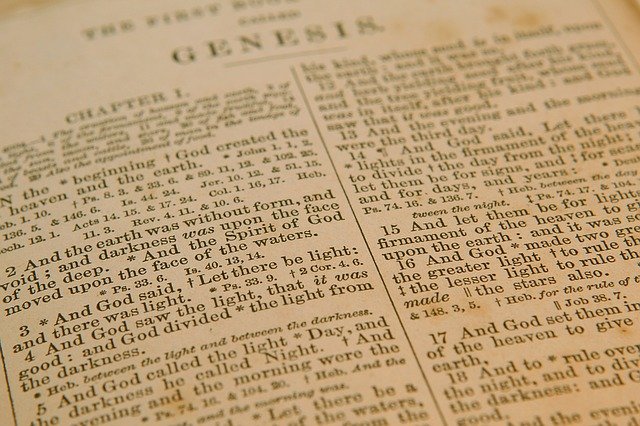
Image by Shutterbug75 from Pixabay

A faith that does not waver

HIGHLIGHT

Romans 4:19 (ESV): 19 He did not weaken in faith when he considered his own body, which was as good as dead (since he was about a hundred years old), or when he considered the barrenness of Sarah’s womb.

EXPLAIN

In the first several chapters of Romans, Paul first established that all have sinned and deserve God’s wrath, both Jew and Gentile. Then, Paul explained that we cannot be made righteous by obeying the law. We must believe in Christ, who makes us righteous by his sacrificial death on Calvary.

Paul’s primary example for grace by faith in Jesus alone is Abraham. Even Abraham was not circumcised (a singular expression of obedience to the Law in that day) before he was justified by God. Rather, Abraham believed God’s promise.

Furthermore, Abraham’s faith in God did not weaken as he and Sarah grew older, yet did not have children. Rather, he continued to believe against hope that he would be the father of many nations (Romans 4:18).

APPLY

We must follow the example of our father in the faith and believe God’s promise. Furthermore, our faith must grow stronger, not weaken, as we continue to follow Jesus.

We know that Abraham did question God, wondering why God had not given him a son sooner. We know that Abraham and Sarah got ahead of God’s plan, believing that Sarah’s servant could produce the heir God promised.

Despite his questions and misstep, however, Abraham did believe God – and he did not waver in his belief that God would keep his promise.

RESPOND

Heavenly Father, help me to imitate Abraham’s example of unwavering faith, holding tightly to your promises, believing you always. Amen.

Our confidence and hope

HIGHLIGHT

Job 4:6 (ESV): 6 Is not your fear of God your confidence, and the integrity of your ways your hope?

EXPLAIN

Eliphaz the Temanite was the first of Job’s friends to speak and to try to make sense of the tragedy Job had experienced.

In verses 3-4, Eliphaz spoke of Job’s various good deeds. And in verse 6, he suggested that fear of God and integrity in one’s ways gives us confidence and hope.

There is truth in what Eliphaz said. We do find confidence when we know we are living a holy life before God.

Yet there is a danger here also. Our fear of God and integrity comes through our faith in God and our resulting faithfulness, aided by the Spirit, to God. Furthermore, confidence and hope do not preclude trouble from coming our way.

Eliphaz continued down this train of thought to suggest that Job couldn’t be truly pure before holy God. Therefore, he argued, Job had sinned and therefore God was punishing him or allowing this difficulty in his life.

This, of course, was not true. God had commended Job as most upright, but still allowed Satan to test him. The tragedies Job had experienced were not the consequence of any sin he had committed.

APPLY

1 John 3 emphasizes this truth.

1 John 3:14 (ESV): 14 We know that we have passed out of death into life, because we love the brothers. Whoever does not love abides in death.

1 John 3:21–22 (ESV): 21 Beloved, if our heart does not condemn us, we have confidence before God; 22 and whatever we ask we receive from him, because we keep his commandments and do what pleases him.

Our confidence is not found in our goodness, but rather in that by grace through faith God has redeemed and renewed us; therefore, our changed life is evidence of God’s grace.

If our faith is in God and we are striving by his help to live holy, we can have confidence and hope even though we may suffer difficulty and setback in life.

RESPOND

Heavenly Father, my hope is in you. Thank you for your grace. Continue to change me to be more like you. Amen.

Singing in the Pain

HIGHLIGHT

Acts 16:25 (ESV): 25 About midnight Paul and Silas were praying and singing hymns to God, and the prisoners were listening to them,

EXPLAIN

Paul was traveling on his second missionary journey with Silas, having gone separate ways from Barnabus and John Mark. He first visited some of the churches that he had started on his first mission trip, and asked Timothy to join him.

After going through Phrygia and Galatia, Paul began hitting roadblocks. He wanted to go into Asia, but the Holy Spirit forbade him. He then desired to go up to Mysia, but the Holy Spirit stopped him again.

Finally, Paul had a vision of a man in Macedonia urging him to come and help them. Paul immediately set sail for that area and was able to have some progress preaching and teaching in Philippi.

But a demon-possessed slave girl followed Paul and his companions everywhere and undermined his message by loudly crying out that these men were servants of the Most High God.

Paul finally cast the demon out of the girl. The girl no longer was able to tell fortunes and her owners seized Paul and Silas, who were beaten by the city rulers and cast into prison.

With their feet fastened in stocks, a torturous practice, Paul and Silas were left suffering in prison for the night. But instead of crying out and despairing, these missionaries sang in their pain, and God provided an earthquake to set them free.

APPLY

Paul and Silas provide a great example for how we should respond to suffering and indignity for the name of Jesus. Instead of moaning, complaining, seeking revenge, or feeling bitter, we should sing in the midst of our pain, entrusting ourselves to Lord Jesus.

Singing in the pain keeps our spirit sweet, demonstrates trust in our Heavenly Father, and robs our enemy of any joy he might feel in inflicting harm upon God’s people.

RESPOND

Heavenly Father, help me to respond to difficulties in life with singing praise to you. May my spirit be sweet and my attitude jubilant because of your love for me and my hope in you. Amen.